


Subtotal $0.00
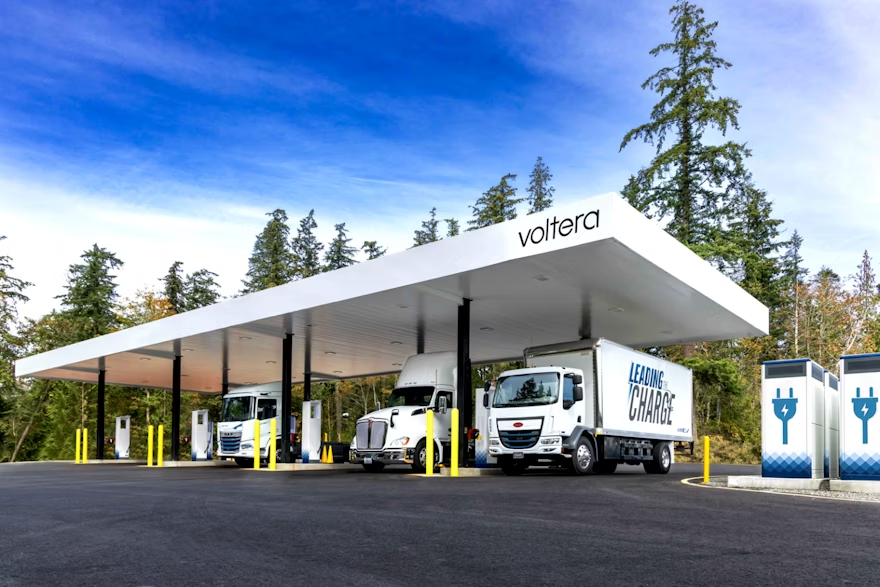
Technically, sometimes. Practically, rarely. Many electric trucks use the same CCS1 plug as electric cars, so they can connect to some public fast chargers. But most public charging stations were designed for passenger vehicles. They’re too small for a tractor-trailer to enter, too low-powered to recharge a truck-sized battery in reasonable time, or both. That’s why most electric trucks today charge at their own depots.
A small but growing network of truck-specific public charging sites is changing that, mainly in California and along key freight corridors. This guide explains why typical public chargers don’t work well for trucks, what does work and how to plan around the gaps.
Why Most Public Chargers Don’t Work for Semi-Trucks
1. Physical access
A tractor-trailer combination is roughly 70 feet long. Most public EV charging spots are standard parking spaces in retail lots, designed for cars to back in or pull in nose-first. A truck can’t fit, can’t turn in and can’t block multiple spaces and drive aisles without disrupting the site. Truck charging needs pull-through lanes, wide turning radii, pavement rated for heavy axle loads and room for trailers.
2. Power and charging time
A Class 8 electric tractor carries a battery several times larger than a car’s, often 400 to 600+ kWh. Charging time depends on power:
| Charger power | Time to add ~300 kWh (approx.) | Typical location |
|---|---|---|
| 19 kW (AC Level 2) | ~16 hours | Workplaces, retail |
| 50 kW (DC) | ~6 hours | Older public fast chargers |
| 150 kW (DC) | ~2 hours | Many public fast chargers |
| 350 kW (DC) | ~1 hour | Newer high-power public sites |
| 1 MW+ (MCS) | ~20–30 minutes | Emerging truck-specific sites |
Real-world times run longer because charging slows as the battery fills, and the truck’s own maximum charging rate may be lower than the charger’s.
Many trucks also have their own limits. For example, some Class 8 models accept DC charging only up to about 120 to 250 kW, no matter how powerful the station.
3. Connector compatibility
Most North American electric trucks use the CCS1 connector. The Tesla Semi uses Tesla’s own Megacharger system. Passenger-car networks increasingly use the North American Charging Standard (NACS, SAE J3400), and the industry is moving toward the Megawatt Charging System (MCS) for heavy trucks. Always check that your truck and the station are compatible before routing a driver there.
4. Network rules and payment
Some public networks restrict access by vehicle size or require specific apps, accounts or reservations. Fleet cards and fleet billing accounts for charging are still maturing.
5. Reliability and availability
A diesel truck stop has many pumps. A public charging site may have a handful of chargers, and if one is down or occupied, waiting can cost hours. Fleets can’t plan tight schedules around uncertain availability.
Where Electric Trucks Actually Charge Today
| Charging type | Who uses it | Pros | Cons |
|---|---|---|---|
| Depot charging (fleet-owned) | Most electric truck fleets | Lowest cost per mile; fleet controls access | Up-front cost; utility power can take 1–3 years |
| Charging-as-a-service | Fleets without capital or space | Provider handles equipment and sometimes power | Per-kWh or monthly fees |
| Shared or truck-specific public hubs | Drayage, regional, owner-operators | No site build; truck-friendly layouts | Limited locations; pricing varies |
| Customer or partner sites | Fleets with regular stops | Uses dwell time at destinations | Requires agreements |
| Public car-focused fast chargers | Occasional emergency use (bobtail) | Widely available | Access, power and time limits |
The Growing Public Truck Charging Network
Purpose-built heavy-duty charging hubs have opened in recent years, mostly in California around the Ports of Los Angeles and Long Beach, the Inland Empire and the Central Valley, with sites emerging along freight corridors such as I-5, I-10 and I-15. Companies building and operating these sites include charging-as-a-service providers and truck-focused networks, often in partnership with utilities and truck manufacturers. Truck makers and energy companies have also opened shared public truck charging sites, including one in Portland, Oregon, built by Portland General Electric and Daimler Truck North America that is prepared for megawatt charging.
Tesla is building Megacharger sites for its Semi, and several networks have announced plans for megawatt charging along major corridors. Many announced sites never get built or open later than planned, so check what’s operating before planning routes around it.
To see current locations, use:
- The ZEV Help Heavy-Duty Truck Charging Map and Station Data Dashboard
- The U.S. Department of Energy’s Alternative Fuels Data Center station locator (afdc.energy.gov/stations), which lets you filter for stations that accommodate heavy-duty vehicles
How to Plan Around Limited Public Charging
- Design routes around your depot first. Choose routes where trucks return to base with charge to spare.
- Use dwell time. Loading, unloading and driver breaks are charging opportunities if you can get access at those locations.
- Identify truck-friendly backup sites along each route, and confirm they’re operating, compatible and accessible for your configuration.
- Call ahead or reserve where networks allow it.
- Factor public charging costs into your budget. Public truck charging usually costs much more per kWh than depot charging, which can quickly erase fuel savings (see Diesel vs. Electric Trucks: Total Cost of Ownership).
- Train drivers on connector types, apps, payment and what to do if a charger is down.
- Consider charging-as-a-service if you lack the space, capital or power to build your own depot.
What to Ask Before Relying on a Public Truck Charger
Before you route a driver to a public site, get answers to these questions:
- Is the site open to the public or reserved for contracted fleets?
- Can it accommodate a full tractor-trailer with pull-through access, or only a bobtail tractor?
- What connector and power level does it offer, and what will your truck actually accept?
- How many charging positions are there, and can you reserve a time slot?
- What does it cost, and how does billing work for fleet accounts?
- What is the site’s uptime record, and who do drivers call if a charger fails?
- Are there restrooms, parking and safe waiting areas for drivers during charging?
The Bottom Line
Electric semi-trucks can use some public chargers, but most stations built for cars are a poor fit because of space, power, connector and reliability limits. Today, depot charging is the backbone of electric truck operations, supported by a growing but still limited set of truck-specific public hubs, mainly in California. As megawatt charging rolls out along freight corridors, public charging should become more practical for regional and long-haul trucks. Until then, plan for depot charging and treat public charging as a supplement, not a strategy.
Frequently Asked Questions
Can an electric semi use a Tesla Supercharger?
Generally no. Superchargers are designed for passenger vehicles. Tesla Semi uses Tesla’s dedicated Megacharger sites, and other electric trucks typically use CCS1 or emerging MCS chargers.
Can a semi-truck charge at a regular EV station?
Sometimes, if the connector matches and the truck can physically access the charger, often only when bobtailing (without a trailer). Charging is usually slow relative to the truck’s battery size.
Are there truck stops for electric semi-trucks?
A growing number of truck-specific charging hubs exist, mainly in California and along some freight corridors. Check the AFDC station locator and the ZEV Help charging map for current sites.
How much does public truck charging cost?
Prices vary by network and location, but public truck charging is usually much more expensive per kWh than depot charging, sometimes enough to cost more per mile than diesel.
Sources and Further Reading
- ZEV Help, Fleet Charging Guide, Charging Map and Charging Infrastructure
- U.S. Department of Energy, Alternative Fuels Data Center station locator: afdc.energy.gov/stations
- CharIN, Megawatt Charging System: www.charin.global/technology/mcs
ZEVhelp.com is an independent, technology-neutral educational resource. This article is for general information only and is not legal, tax or financial advice. Regulations and incentives change often; for official rules, refer to EPA.gov, ARB.CA.gov and your state agencies. Last reviewed October 2026.

Comments are closed